
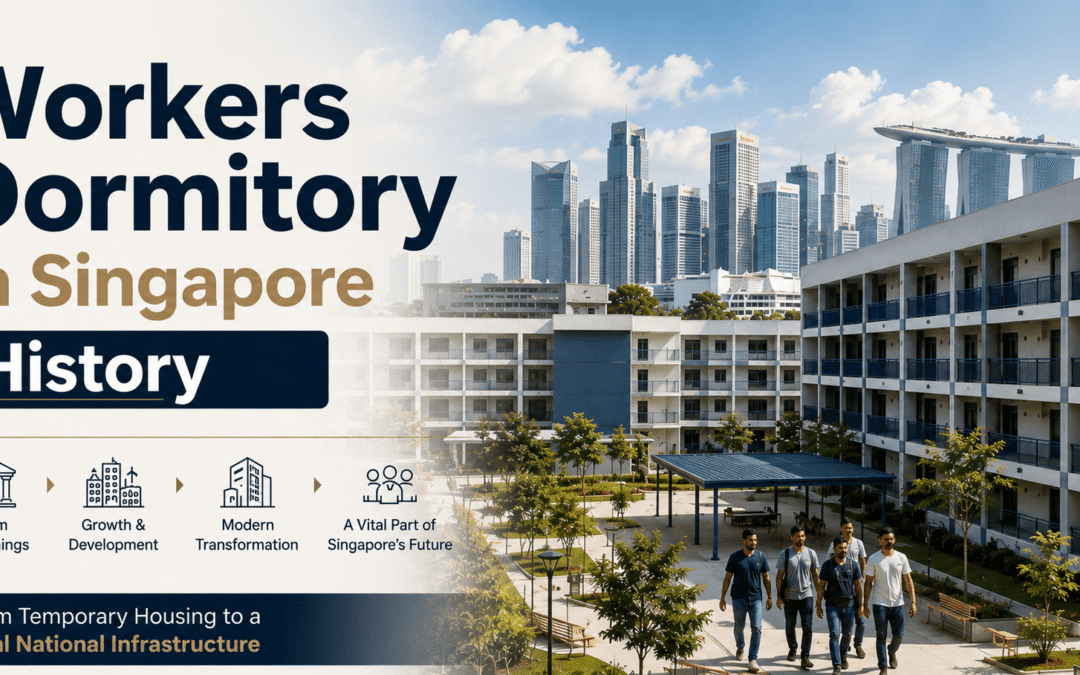
Why Is the History of Workers’ Dormitories in Singapore Important Today? Singapore’s remarkable economic success did not happen overnight. Behind its iconic skyline, world-class infrastructure, and thriving industrial zones lies a large workforce that has continuously driven the country’s development. Among them, migrant workers have played a critical role in the construction, manufacturing, marine, and essential service sectors that support Singapore’s economy.
An important question is: Where do these workers live, and how did Singapore develop one of Asia’s most well-regulated and internationally recognized workers’ dormitory systems?
Understanding the Workers Dormitory in Singapore History provides more than a timeline of worker accommodation. It offers valuable insight into how Singapore’s housing policies have evolved alongside its economic growth. For real estate investors, property developers, and industry professionals, this history demonstrates how strategic planning and government policy have transformed workers’ housing into a key component of national infrastructure.
Today, workers’ dormitories are no longer simply places to sleep. They are purposefully designed communities that promote quality of life, public health, safety, and efficient workforce management.
How Did Workers’ Dormitories Begin in Singapore?
Singapore’s dependence on migrant workers increased significantly during the 1970s and 1980s, when rapid industrialization and large-scale infrastructure development created a demand for labor that exceeded the capacity of the local workforce.
During this early period, foreign workers were accommodated in various types of housing, including:
- Converted factory buildings
- Temporary housing within construction sites
- Commercial buildings
- Rental rooms and apartments
- Small dormitories provided by employers
While these arrangements met immediate housing needs, accommodation standards varied greatly depending on the employer or property owner, and there was no unified regulatory framework.
As the migrant worker population continued to grow, the Singapore government recognized that long-term planning was essential. Providing adequate accommodation could no longer rely solely on temporary or employer-managed solutions.
Why Did Singapore Transition to Purpose-Built Dormitories?
The shift toward Purpose-Built Dormitories (PBDs) was driven by several important considerations.
First, concentrating workers within professionally managed dormitories made it easier to oversee security, transportation, sanitation, healthcare, and emergency response.
Second, larger dormitories could provide comprehensive facilities that significantly improved living conditions, including:
- Food courts and dining facilities
- Recreational areas
- Medical clinics
- Convenience stores
- Laundry facilities
Purpose-built dormitories also enabled the government to establish consistent accommodation standards across the industry.
According to Singapore’s Ministry of Manpower (MOM), Purpose-Built Dormitories play a vital role in managing the foreign workforce while improving workers’ well-being and supporting operational efficiency for businesses.
How Has Legislation Shaped the History of Workers’ Dormitories?
One of the defining characteristics of the Workers Dormitory in Singapore History is the government’s strong regulatory framework.
Singapore introduced the Foreign Employee Dormitories Act (FEDA) to regulate large-scale dormitories and establish minimum operational standards. The legislation covers key areas such as:
- Fire safety
- Sanitation and hygiene
- Security management
- Maintenance requirements
- Living standards
- Responsibilities of dormitory operators
This legal framework demonstrates that Singapore views workers’ dormitories not merely as rental properties, but as essential infrastructure supporting the national economy.
Clear regulations also provide greater confidence for investors by creating transparent operational standards and reducing uncertainty within the sector.
How Did COVID-19 Transform Workers’ Dormitories?
One of the most significant milestones in the history of workers’ dormitories was the COVID-19 pandemic in 2020.
Outbreaks within migrant worker dormitories exposed the challenges associated with high-density accommodation and prompted comprehensive reforms across the sector.
Major improvements included:
- Greater access to healthcare services
- Enhanced ventilation systems
- Reduced residential density
- Higher hygiene standards
- Dedicated isolation facilities
- Improved emergency preparedness
These reforms fundamentally changed the design philosophy of modern workers’ dormitories, making health, safety, and resilience central priorities in future developments.
 p
p
How Have Workers’ Dormitories Changed Over Time?
Although the primary purpose of workers’ dormitories remains the same—providing accommodation for migrant workers—the philosophy behind their design and management has evolved dramatically.
In the past, most dormitories focused primarily on maximizing occupancy to meet immediate labor demands, often placing less emphasis on living quality or resident well-being. As a result, accommodation standards varied significantly among operators.
Today, the industry has shifted toward professionally managed communities designed to improve residents’ overall quality of life.
| Past | Present |
| Temporary accommodation | Long-term planned dormitories |
| Limited facilities | Comprehensive amenities |
| Managed mainly by employers | Professionally operated facilities |
| Inconsistent standards | Unified regulations and standards |
| Focused primarily on accommodation | Emphasis on quality of life |
| Limited healthcare access | Integrated healthcare and public health support |
This transformation illustrates Singapore’s transition from simply providing housing to creating well-managed residential communities that prioritize safety, health, sustainability, and operational efficiency. Workers’ dormitories have become an integral part of the country’s long-term economic infrastructure.
Why Is Singapore’s Approach Different from Many Other Countries?
In many countries, employers remain primarily responsible for providing accommodation for migrant workers. Housing arrangements often vary depending on company size, industry, and local regulations, resulting in significant differences in safety, hygiene, and living standards.
Additionally, regulatory oversight is frequently shared among multiple government agencies, making consistent enforcement more challenging.
Singapore, however, has developed an integrated system that includes:
- Urban planning specifically for workers’ dormitories
- Dedicated legislation
- A licensing framework
- Professional dormitory operators
- Continuous policy improvement
Although Singapore’s model is internationally recognized and frequently referenced as a benchmark for migrant worker accommodation, it continues to generate discussion regarding the balance between operating costs, workers’ quality of life, business competitiveness, and long-term sustainability. These are challenges faced by every country that relies on foreign labor.
Conclusion
The Workers Dormitory in Singapore History reflects far more than the evolution of migrant worker accommodation. It represents the parallel development of Singapore’s economy, urban planning, public policy, and social responsibility.
From modest temporary housing during the country’s early industrialization to today’s professionally managed residential communities, workers’ dormitories have become a critical piece of national infrastructure that supports economic growth while improving workers’ living conditions and enhancing business efficiency.
For real estate investors and developers, understanding this history demonstrates that workers’ dormitories are more than just another property asset. They are long-term infrastructure investments that continue to play an essential role in Singapore’s economic development.