
For employers in Singapore, worker accommodation is not simply a monthly rental expense. The real worker dormitory cost depends on location, room and bed configuration, facilities, regulatory requirements, transport needs, contract terms, and the level of management provided by the dormitory operator.
That is why two dormitories with different rental rates can produce very different total costs for the same workforce. A lower-priced bed may seem economical, but longer daily travel, additional shuttle arrangements, limited facilities, or higher administrative demands can increase the overall housing cost.
Understanding these factors helps employers compare accommodation more accurately and choose a dormitory that fits both budget and operational needs.
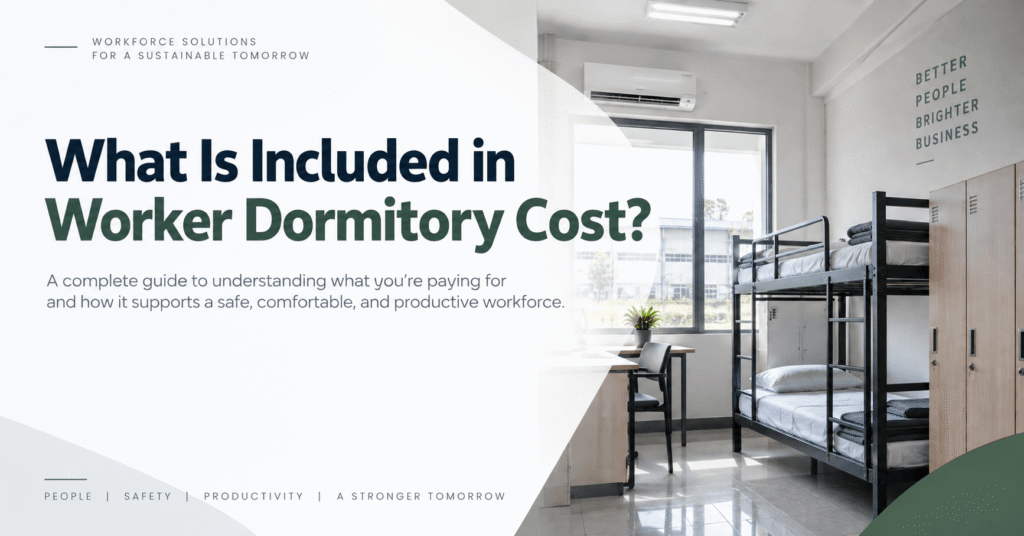
What Is Included in Worker Dormitory Cost?
There is no single standard rate for every worker dormitory in Singapore. Pricing varies by property, location, number of workers, accommodation arrangement, services included, and length of stay.
Before comparing quotations, employers should establish exactly what the quoted amount covers. Depending on the operator and agreement, charges may include or exclude utilities, transportation, security, maintenance, common-area cleaning, deposits, and administrative services.
For a meaningful comparison, look at the total expected monthly expense rather than only the headline rate per bed.
Cost Per Bed vs. Total Workforce Housing Cost
Suppose a company houses 100 workers in a lower-priced dormitory located far from the worksite. If the company must add buses, extra trips, or longer transport windows, the apparent rental savings may shrink quickly.
A slightly higher accommodation rate can sometimes produce lower overall operating costs when the dormitory is closer to the workplace or better connected to regular transport routes.
1. Dormitory Location
Location is one of the biggest factors affecting the practical cost of worker accommodation.
Dormitories near major industrial clusters can help employers reduce travel time and simplify daily workforce movement. For businesses with early shifts, rotating schedules, or several transport runs each day, location can directly affect transport planning and cost.
Avery Dormitories operates accommodation at Avery Lodge at Jalan Papan, Kian Teck Dormitory in the west, Tampines Dormitory in the east, and Woodlands Dormitory in the north. Across its network, Avery states that it has approximately 23,000 beds.
Why Distance From the Worksite Matters
When evaluating worker dormitory cost, calculate the route between the dormitory and the worksite, not just the rental price. Consider the number of daily shuttle trips, travel time during shift changes, transport contractor charges, and whether workers are deployed across one or multiple worksites.
For companies with teams spread across Singapore, using more than one dormitory location may sometimes be more efficient than housing everyone at a single property.
2. Dormitory Type and Accommodation Standard
Different forms of worker housing come with different infrastructure, operating models, and regulatory requirements.
The Ministry of Manpower (MOM) identifies several types of housing for foreign employees, including Purpose-Built Dormitories (PBDs) and Factory-Converted Dormitories (FCDs). Purpose-Built Dormitories are specifically designed for foreign employee accommodation and may include amenities such as dedicated cooking areas, minimarts, laundry services, and recreational facilities.
A purpose-built property with comprehensive facilities may therefore have a different pricing structure from a more basic accommodation arrangement.
Room Layout and Occupancy
Room configuration can also influence cost. The number of residents sharing a room, available living space, bathroom arrangements, lockers, and common areas all affect how accommodation is planned and managed.
Employers should confirm what type of bed or room is being quoted and whether the arrangement suits their workforce.
3. Facilities and Amenities Provided
Facilities add value, but they also require space, staffing, maintenance, and utilities. Depending on the dormitory, residents may have access to cooking areas, canteens, minimarts, gyms, TV rooms, laundry facilities, ensuite bathrooms, lockers, and security systems.
Avery Lodge and Kian Teck Dormitory, for example, list cooking facilities, gyms, canteens, TV rooms, minimarts, ensuite bathrooms, lockers, and 24-hour security with CCTV and access control.
For employers, the key question is whether these amenities support workers’ daily needs, safety, and well-being—not simply whether the property has more facilities.
4. Regulatory Compliance and Licensing
Compliance is a core part of legitimate worker accommodation in Singapore and can affect both development and operating costs.
Under the Foreign Employee Dormitories Act (FEDA), operators managing dormitory premises that can house seven or more migrant workers are required to obtain a FEDA licence before operating the dormitory and accepting residents. Depending on the dormitory type and property, approvals from other agencies such as the Urban Redevelopment Authority (URA) and Singapore Civil Defence Force (SCDF) may also be required.
These requirements mean that worker dormitory cost is partly influenced by the resources needed to maintain compliant facilities, safety systems, sanitation standards, inspections, and professional management.
Why Employers Should Verify Compliance
Employers should confirm that proposed housing is suitable for foreign employees and that the relevant approvals and licensing requirements are in place.
MOM states that employers must carry out due diligence to ensure that the specific housing requirements for their foreign employees are met. Failure to meet these obligations may result in enforcement action and restrictions on hiring foreign employees.
A compliant, professionally managed dormitory can also reduce the administrative burden of addressing accommodation issues after workers move in.
5. Security, Maintenance and On-Site Management
The level of day-to-day management is another cost factor that is easy to overlook.
Dormitories need regular maintenance, security, resident support, fault reporting, and common-area management. Properties with dedicated management teams, 24-hour security, CCTV, and controlled access naturally require operating resources.
However, these services can also reduce disruption for employers because accommodation-related matters can be handled directly by the dormitory operator.
When reviewing a quotation, ask who is responsible for maintenance, resident support, incident response, access management, and common-area upkeep.
6. Number of Beds and Length of Stay
The size and duration of a booking can affect commercial terms.
An employer requiring a small number of beds for a short project may receive a different arrangement from a company securing a larger number of beds for a longer period. Availability also matters when many workers need to stay in the same location.
To receive a more accurate quotation, employers should provide the required number of beds, move-in date, intended length of stay, workforce location, and any expected changes in headcount.
Providing this information early also allows the accommodation provider to assess whether one dormitory or several locations would better suit the employer’s workforce deployment.
7. Contract Terms and Additional Charges
Two quotations with similar monthly rates may still create different total financial commitments.
Review the accommodation agreement carefully and check for deposits, notice periods, early termination conditions, minimum booking periods, utility arrangements, transport charges, and other applicable fees.
MOM recommends that employers sign a written tenancy agreement with the dormitory operator. A clear agreement helps both parties understand what is included and who is responsible for each part of the accommodation arrangement.
Employers should therefore avoid comparing quotations solely on the monthly figure shown at the top of the proposal.
How Should Employers Compare Worker Dormitory Costs?
A useful comparison should combine accommodation cost with operational cost.
Instead of asking only, “Which dormitory has the cheapest beds?”, compare: Monthly accommodation cost + transport cost + additional services + administrative impact + suitability for workers.
This gives a more realistic view of the total worker dormitory cost to the business.
For example, a dormitory with a lower monthly bed rate but significantly higher transport requirements may not necessarily be the more economical option. Likewise, accommodation with suitable facilities, responsive management, and a convenient location may reduce other costs that are not immediately visible in the rental quotation.
A dormitory that is well located, properly managed, appropriately equipped, and compliant with Singapore’s housing requirements may therefore offer better overall value even when the headline rental price is not the lowest.
Finding the Right Worker Dormitory in Singapore
The right accommodation depends on workforce size, workplace location, operating schedule, budget, and the level of facilities and management required.
Avery Dormitories provides professionally managed worker accommodation across four locations in Singapore, with approximately 23,000 beds across its network. Avery also states that it manages the full lifecycle of its properties, from development and licensing to daily operations and ongoing maintenance.
If you are comparing worker dormitory cost for an upcoming project or an existing workforce, start with four details: the number of beds required, worksite location, move-in date, and expected duration.
With these requirements established, Avery Dormitories can help identify a suitable accommodation option and provide a quotation based on your company’s actual workforce housing needs.