
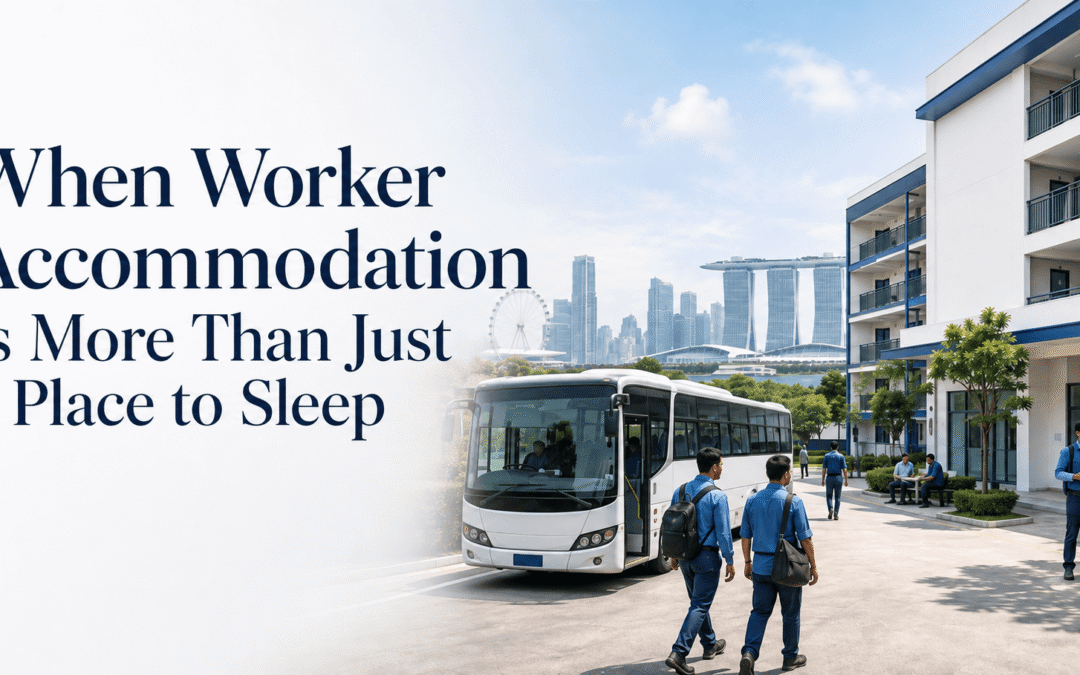
Imagine a company in Singapore employing 300 foreign workers. Every morning, buses need to pick employees up from their dormitory before their shifts begin. Some workers spend more than an hour commuting. After work, they make the same journey back. One day, the shuttle was delayed. Another day, an issue arises within the accommodation. Before long, the HR team starts receiving questions about employees’ living conditions.
When choosing accommodation, a company may initially focus on two simple criteria: whether there are enough beds for all 300 workers and whether the price fits the budget. But once operations begin, it becomes clear that a Dormitory is not merely an Accommodation expense. It is closely connected to Transportation, Employee Well-being, and day-to-day Workforce management.
This perspective is part of what distinguishes Avery Dormitories from a conventional accommodation provider. Rather than simply providing residential space, Avery places importance on Location, the Living Environment, and ongoing management throughout the operational life of each Dormitory.
What Hidden Costs Can a Poorly Located Dormitory Create?
When companies search for a Foreign Worker Dormitory, one of the first factors they tend to compare is the cost per bed.
Suppose there are two options. Dormitory A is cheaper, but workers need approximately 50 minutes to travel from the accommodation to the worksite. Dormitory B costs slightly more but reduces the journey to just 20 minutes. If monthly rent is the only consideration, Dormitory A may appear to be the obvious winner.
However, once transportation costs, shuttle arrangements, hours lost to commuting, employee fatigue, and the complexity of transport scheduling are taken into account, the picture can change completely.
This is why location should not be viewed simply as an address. It should be considered part of Workforce Planning.
Avery Dormitories operates accommodation across several areas of Singapore, including Avery Lodge, Kian Teck Dormitory, Tampines Dormitory, and Woodlands Dormitory. This gives employers greater flexibility to consider accommodation locations in relation to where their workers are actually deployed.
For teams working around Tuas or Jurong, accommodation requirements may be very different from those of companies operating near Changi, Loyang, or Woodlands. The real question, therefore, is not simply, “Which dormitory is better?” but rather, “Which dormitory is better suited to our company’s Operational Footprint?”

What Can a Worker’s Evening Routine Tell Us About Dormitory Quality?
After completing a full shift, a worker may return to the dormitory at around 7 p.m. They need to shower, eat, contact their family, perhaps buy a few daily necessities, rest, and prepare for the following day.
This is why a dormitory should not be designed solely around how many people can fit within a given space.
Cooking areas, lounges, a canteen, mini-mart, gym, TV room, and other communal spaces may appear to be additional Facilities, but in practice, they form part of everyday routines repeated hundreds of times throughout the year.
Several dormitories within the Avery network provide facilities that support these activities, together with security systems, access control, and CCTV.
This approach reflects what Avery describes as its People-first Philosophy. Put simply, the starting question is not, “How many people can we fit here?” but rather, “If people are going to live here every day, what will they actually need?”
Do Employers Really Need to Care About Workers’ Quality of Life After Work?
There is another reasonable perspective. Some companies may argue that an employer’s primary responsibility is to provide accommodation that complies with applicable requirements, while employees’ leisure time and quality of life outside working hours remain personal matters.
From a legal or administrative perspective, this may appear to be a clear division of responsibility.
In real-world Workforce management, however, the boundaries are rarely so simple.
Employees who do not get sufficient rest, spend long periods commuting, or live in a problematic environment do not simply leave those experiences at the dormitory door when they arrive at work the next morning.
At the same time, companies do not necessarily need to choose the dormitory with the greatest number of amenities. What matters is whether the accommodation is appropriate for the type of workforce, the number of workers, the duration of their stay, and their working arrangements.
In other words, choosing what is most suitable is often more important than choosing what offers the most.
Is a Good Building Enough If No One Manages It After It Opens?
Consider two dormitories. The first is a newer building with a comprehensive range of facilities. However, when a light fails, a bathroom develops a problem, or a communal area needs repair, residents are unsure whom to contact.
The second may not appear more impressive at first glance, but it has an on-site team, a defined maintenance process, and clear operational responsibilities.
For long-term accommodation, the difference between these two models becomes increasingly important over time.
Avery Dormitories adopts an End-to-End Management approach that goes beyond building or preparing accommodation. Its management scope covers Development, Licensing, Daily Operations, and Ongoing Maintenance.
What employers receive, therefore, is not simply physical space. It is an operational system designed to help that space continue functioning effectively in everyday use.
This becomes particularly important for companies managing hundreds or thousands of workers. A small issue affecting an individual resident can quickly develop into a broader Operational Problem when there is no clear system for addressing it.

Should Compliance Be a Selling Point or Simply the Minimum Standard?
When discussing Foreign Worker Accommodation in Singapore, operational and regulatory requirements cannot be ignored.
Avery manages its dormitories with attention to requirements under the Foreign Employee Dormitories Act (FEDA).
However, there is an important distinction to make: Compliance should not be the only reason for choosing a dormitory. Meeting regulatory requirements should be a fundamental expectation of an accommodation provider.
Once that baseline has been established, companies should ask additional questions:
- Is the accommodation conveniently located in relation to the worksite?
- Is there an actual management team responsible for the property?
- Are communal spaces suitable for the number of residents?
- What security systems are in place?
- Is maintenance handled consistently?
- If the workforce expands in the future, does the provider have sufficient Capacity to accommodate that growth?
Approaching the decision this way turns Compliance into a Starting Point, rather than the Ending Point of the selection process.
Why Does Avery Operate More Than One Dormitory?
One advantage of having multiple locations is the ability to match worker accommodation with the areas in which employees actually work.
For example, marine or manufacturing companies with worksites in western Singapore may place greater emphasis on locations such as Avery Lodge or Kian Teck Dormitory.
Companies operating around Changi, Loyang, or industrial areas in the east may consider Tampines Dormitory, while workforces based around Woodlands, Senoko, or Sembawang face a different commuting context altogether.
From this perspective, a dormitory network is not valuable simply because it offers “more locations.” Its real value lies in providing options for organising a Workforce according to Geography.
This can be particularly useful for companies operating multiple worksites. Rather than accommodating the entire workforce in one location and transporting workers in different directions every morning, companies can consider how accommodation locations align with their operational footprint.
What Types of Companies Could Benefit from Avery Dormitories?
Avery may be worth considering for companies that are looking for more than simply available beds for their workers. It may be particularly relevant to organisations seeking an accommodation provider that views worker housing within the broader context of Workforce Management.
This includes organisations with large workforces, companies operating across different industrial areas, and HR or Operations teams seeking to reduce the complexity involved in managing long-term worker accommodation.
With multiple locations, a People-first Philosophy, End-to-End Management, and an emphasis on Compliance, Security, and Maintenance, Avery Dormitories positions itself as more than simply “a building with beds for rent.”
Ultimately, workers do not spend their entire lives inside factories or worksites. Every day, they also need to commute, eat, rest, communicate with their families, and live their lives outside working hours.
When a company employs hundreds or thousands of workers, the quality and efficiency of those hours outside work can, in turn, influence how effectively the workforce — and the organisation as a whole — is managed.