
If your factory or industrial building is no longer generating its full income potential, should you start looking at worker dormitory conversion as an option?
A factory building that was once a revenue-generating asset can gradually become an underused space with hidden monthly costs, including building maintenance, repairs, taxes, opportunity costs, and the risk of leaving the property vacant for too long. The key question is no longer simply whether you should lease it out again, but whether this property can be transformed into a more stable source of recurring income.
One option that factory owners and industrial property owners in Singapore are increasingly considering is converting their building into a worker dormitory, or accommodation for foreign workers that complies with the required standards. Demand for worker accommodation remains consistent, while properly licensed and compliant dormitories are not easy to create within a short period of time.
For Avery Dormitories, the Worker Dormitory Conversion page on its website clearly states that Avery supports property owners throughout the process, from feasibility assessment, design and building conversion, licensing and compliance management, to long-term dormitory operations.
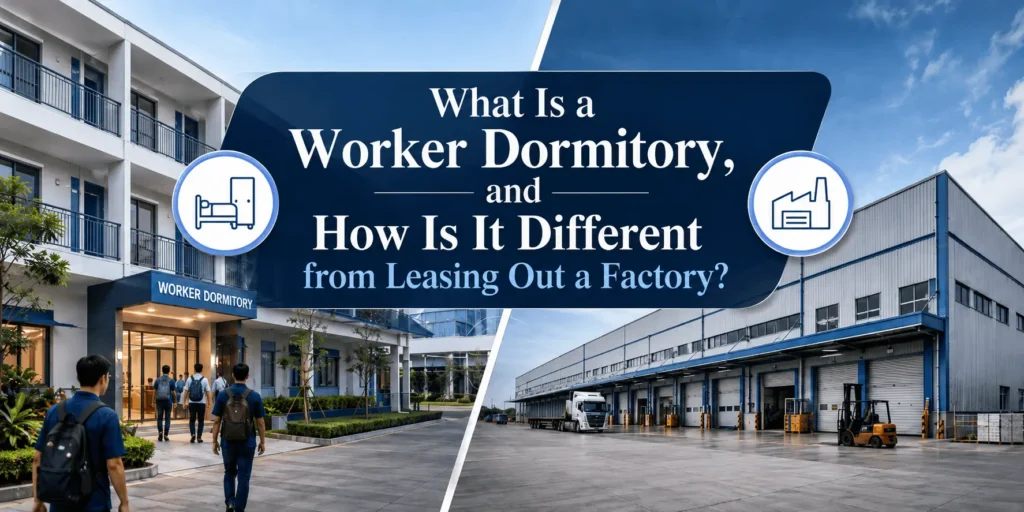
What Is a Worker Dormitory, and How Is It Different from Leasing Out a Factory?
A worker dormitory is accommodation for foreign workers or migrant workers who need to live close to their workplace, especially in sectors such as industry, construction, logistics, manufacturing, and supporting services in Singapore.
This type of accommodation is not simply about dividing a building into rooms. It must take into account safety, hygiene, resident management, facilities, transportation, and requirements from relevant authorities.
The Ministry of Manpower Singapore states that there are several types of worker accommodation. Factory-Converted Dormitories, or FCDs, refer to industrial buildings or warehouses that have been partially converted into worker dormitories. This is where some factory owners see an opportunity, as an existing building may be redeveloped instead of being leased only as a conventional industrial space.
By comparison, traditional factory leasing often depends on one tenant or a limited number of tenants. If the tenant moves out, the income may disappear immediately. A well-managed worker dormitory, however, may be able to generate more consistent recurring rental income.
That said, attractive income potential also comes with greater operational complexity, including licensing, resident management, maintenance, and living-standard requirements.
Why Is Factory-to-Worker-Dormitory Conversion an Attractive Opportunity?
The main reason is that demand and supply do not always move at the same pace.
On the demand side, Singapore continues to rely on foreign workers across many industries. On the supply side, compliant worker dormitories must meet legal, building, hygiene, safety, and operational requirements. This means they are not assets that anyone can open and operate immediately.
The Ministry of Manpower Singapore previously announced the expansion of the Foreign Employee Dormitories Act, or FEDA, to cover worker dormitories with seven beds or more from 1 April 2023. This was expected to bring about 1,600 dormitories, or approximately 439,000 beds, under the same regulatory framework. This reflects that the worker accommodation industry is not merely a general real estate business, but a clearly regulated sector.
From a property owner’s perspective, the opportunity lies in turning an underutilized building into an asset that meets both labour market demand and government standards.
However, the most important part is starting correctly. If the assessment is wrong from the beginning, the cost of correcting problems later may be much higher than planning carefully from the start.
What Should You Ask About FEDA and Regulations Before Starting?
The first question to ask is not only whether the building has enough space, but whether it truly has the potential to be approved and operated as a worker dormitory.
According to the Ministry of Manpower Singapore, operators who manage and operate dormitories that can accommodate seven or more migrant workers must obtain a FEDA licence before commencing operations and housing residents.
In addition, the licensing process may involve approvals from other authorities, such as URA Planning or Written Permission and an SCDF Fire Safety Certificate, depending on the type of dormitory.
In practice, property owners should assess several factors at the same time, such as:
Whether the building structure can support conversion works, whether ventilation and sanitation systems are sufficient, whether the access points are suitable for security control, whether parking or worker pick-up and drop-off areas may affect public roads, and whether the location is close enough to work sites to reduce workers’ commuting time.
This is why a feasibility assessment is extremely important. A pre-investment assessment helps determine whether the building is truly suitable for conversion into a worker dormitory, or whether it should be used for another purpose instead.
Managing It Yourself vs Working with an Experienced Partner
Some property owners may think that converting a factory into a worker dormitory can be managed independently in order to reduce operator costs. In reality, however, a worker dormitory business involves real estate, operations, and compliance at the same time.
| Key Consideration | Managing It Yourself | Working with an Expert |
| Building assessment | May focus mainly on usable floor area | Assesses legal, building, system, and income potential together |
| Design and conversion | Higher risk of repeated design revisions if standards are not fully understood | Plans according to requirements from the beginning |
| Licensing | Requires coordination with several authorities independently | Provides support with licensing and compliance |
| Daily operations | Must manage residents, safety, repairs, maintenance, and complaints directly | Has operational systems and a dedicated team for ongoing management |
| Long-term risk | Higher risk due to lack of experience | Reduces complexity and increases operational stability |
Avery provides an end-to-end approach covering development, licensing, daily operations, and ongoing maintenance to ensure the dormitory complies with FEDA requirements and can be managed consistently.
For property owners, the strength of this model is that they do not need to coordinate separately with consultants, designers, contractors, and dormitory operators. This helps reduce the risk of miscommunication and project delays.

What Risks Should Not Be Overlooked?
Although worker dormitory conversion may appear to be an attractive opportunity, it is not the right solution for every building or every property owner.
One important perspective to consider is that converting a factory into a worker dormitory may require a higher upfront investment than expected, especially if major upgrades are needed for sanitation systems, electrical systems, fire safety systems, space planning, and facilities in order to meet required standards.
In addition, managing a worker dormitory is not fully passive income. Residents must be cared for every day, including safety, cleanliness, repairs, maintenance, complaint handling, communication with employers, and maintaining required standards.
Without a strong operational system, the income that was expected to be stable may instead become a long-term burden.
Another important point is that worker accommodation standards in Singapore are likely to continue improving. The Ministry of Manpower Singapore has stated that the Dormitory Transition Scheme requires existing dormitories that are not yet under the New Dormitory Standards to transition to interim standards by 2030 and to the New Dormitory Standards by 2040.
Therefore, property owners should view this type of project from a long-term perspective, not only from short-term returns.
How Do Living Standards Affect the Project’s Return?
The value of a worker dormitory should not be measured only by the maximum number of beds. It should be measured by the number of beds that can be managed safely, legally, and with sufficient quality for residents.
For example, Singapore’s new dormitory standards place greater emphasis on living conditions and public health resilience, such as limiting the number of residents per room, setting minimum living space per person, improving bathroom standards, and preparing isolation areas when necessary.
MOM previously stated that the New Dormitory Standards limit occupancy to no more than 12 residents per room and require at least 4.2 square metres of living space per resident, excluding shared facilities.
From a building owner’s perspective, these requirements may reduce the number of beds compared with initial expectations. On the other hand, higher standards can make the dormitory more credible, reduce health risks, overcrowding, and complaints, and become an important factor in tenant retention and long-term income stability.
How to Choose a Worker Dormitory Conversion Partner to Reduce Risk
The right partner should not be merely a construction contractor or general building manager. They should understand real estate development, FEDA regulations, foreign worker accommodation operations, and resident welfare.
Key criteria to consider include:
Whether the partner has real experience managing worker dormitories, how well they understand the licensing process and regulatory framework, whether they can support the project from feasibility to operations, whether they have systems for safety, maintenance, and resident welfare, and whether they have actual property examples that demonstrate their operational capabilities.
According to information on the Avery Dormitories website, the company states that it has experience in developing and managing worker dormitories in Singapore. It also provides a comprehensive approach and places importance on safety, comfort, maintenance, and shared facilities that support workers’ well-being.
In addition, example properties such as Avery Lodge, Tampines Dormitory, and Woodlands Dormitory highlight strengths such as locations near industrial zones, on-site management teams, 24-hour security, and in-dormitory facilities.
Conclusion: Who Is Factory-to-Worker-Dormitory Conversion Suitable For?
Converting a factory or industrial building into a worker dormitory can be an attractive opportunity for property owners who want to generate long-term income from an existing asset, especially buildings located near industrial areas, with suitable structural potential, and the ability to comply with Singapore’s requirements.
However, the project’s viability does not depend only on the number of beds or expected income. It depends on the accuracy of the initial assessment, licensing readiness, conversion costs, operational capability, and the living standards provided to residents.
For property owners who want to reduce complexity, working with an experienced partner who can handle feasibility, design, licensing, compliance, and operations can improve the chances of project success and reduce the risk of investing in the wrong direction.
Frequently Asked Questions About Worker Dormitories
1. How is a worker dormitory different from a regular dormitory?
A worker dormitory is accommodation for foreign workers or migrant workers that must comply with worker housing, safety, hygiene, and management requirements. It is not simply a general rental dormitory divided into rooms for residential use.
2. Can every factory be converted into a worker dormitory?
No. Not every factory is suitable. The location, zoning, building structure, sanitation system, fire safety system, accessibility, and ability to obtain licences must be assessed before investment.
3. Is a FEDA licence required?
If the dormitory can accommodate seven or more migrant workers, a FEDA licence is generally required before operations begin and before residents are housed, according to information from the Ministry of Manpower Singapore.
4. How long does it take to convert a factory into a worker dormitory?
The timeline depends on the existing building condition, project size, design work, conversion work, and approval process from relevant authorities. If the building requires major system upgrades, the timeline and budget may increase significantly.
5. Is income from a worker dormitory more stable than leasing out a factory?
In some cases, it may be more stable because worker accommodation can generate recurring income from ongoing demand. However, it also comes with greater operational responsibilities and regulatory requirements. The decision should therefore consider income, costs, risks, and operational readiness together.
6. What should be the first step?
The first step should be a feasibility assessment to determine whether the building is suitable for conversion into a worker dormitory. After that, the owner can plan the building design, licensing, budget, and long-term operating model.