
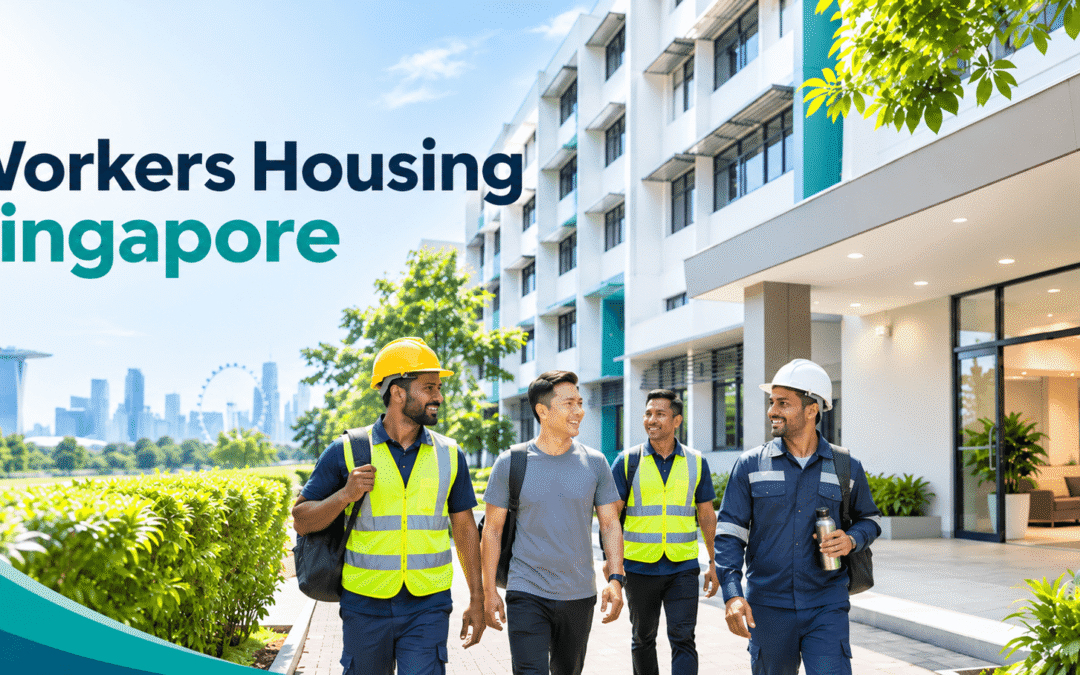
If you have a group of foreign Work Permit holders arriving in Singapore next month, one of the most important questions is: Where will your workers stay, and will their accommodation meet the Ministry of Manpower (MOM) requirements?
Workers housing in Singapore refers to accommodation provided or arranged by employers for foreign workers. Under Singapore law, employers are responsible for ensuring that their workers have suitable accommodation that complies with applicable regulations.
For companies employing larger groups of foreign workers, licensed worker dormitories that comply with MOM requirements and the Foreign Employee Dormitories Act (FEDA) are often a practical choice.
Choosing unsuitable accommodation can expose employers to financial penalties, restrictions on hiring foreign workers, and potential disruptions to employee welfare.
This guide explains the different types of Workers Housing Singapore, the relevant laws and accommodation standards, and how employers can select suitable housing based on workforce size, budget, and workplace location.
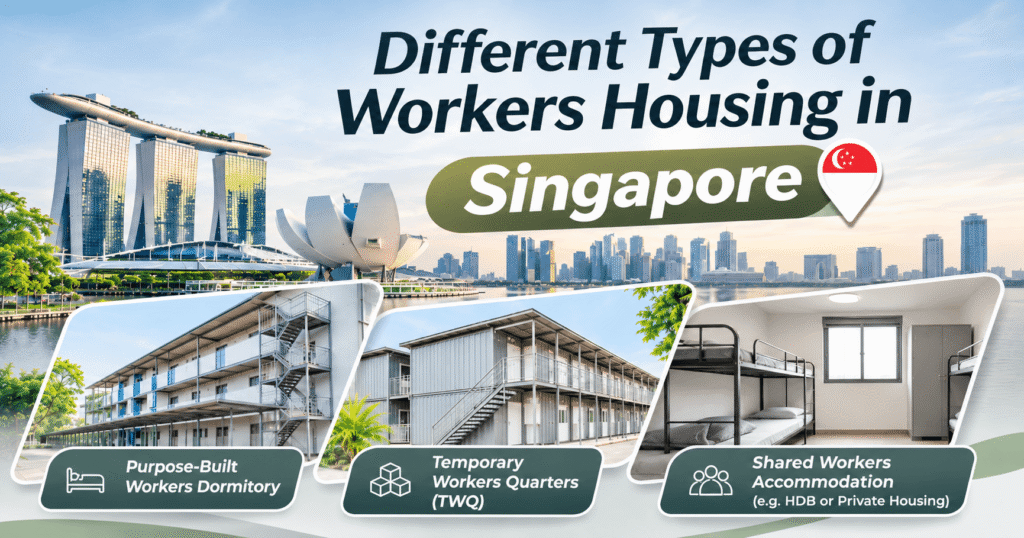
Different Types of Workers Housing in Singapore – Explore the main worker accommodation options available in Singapore, including Purpose-Built Workers Dormitories (PBWD)
What Are the Different Types of Workers Housing in Singapore?
The Ministry of Manpower (MOM) identifies seven main types of accommodation for foreign workers in Singapore. Each category has specific eligibility requirements.
MOM requires employers to verify whether their workers are eligible to stay in their chosen accommodation. Failure to comply with these requirements may result in prosecution or restrictions on employing foreign workers.
1. Purpose-Built Dormitories (PBDs)
Purpose-Built Dormitories are facilities specifically designed and constructed to accommodate foreign workers.
They typically offer shared facilities and services, including convenience stores, cooking areas, laundry services, remittance services, and recreational spaces.
These dormitories are commonly used by companies employing large numbers of foreign workers.
2. Factory-Converted Dormitories (FCDs)
Factory-Converted Dormitories are industrial buildings, factories, or warehouses where designated areas have been converted into accommodation for workers.
They may be suitable for employers seeking accommodation near industrial facilities, subject to applicable approvals and occupancy requirements.
3. Construction Temporary Quarters (CTQs)
Construction Temporary Quarters are temporary accommodation facilities located within construction sites.
They are intended exclusively for construction workers employed on the specific project where the accommodation is situated.
4. Temporary Occupation Licence Quarters (TOLQs)
Temporary Occupation Licence Quarters are temporary housing facilities established on state land near construction projects.
Accommodation is restricted to construction workers associated with the relevant project.
5. Workers’ Quarters at Farms (WQFs)
Workers’ Quarters at Farms provide accommodation specifically for workers employed by the farm owner.
These facilities are subject to eligibility and regulatory requirements.
6. Housing & Development Board (HDB) Flats
Certain foreign Work Permit holders may be eligible to rent HDB flats or rooms, depending on their nationality and employment sector.
For example:
- Malaysian Work Permit holders and eligible workers in the services sector may rent HDB flats, subject to applicable conditions.
- Non-Malaysian Work Permit holders employed in the manufacturing sector may rent rooms in HDB flats but cannot rent an entire flat.
Employers must check the latest HDB and MOM eligibility requirements before arranging accommodation.
7. Private Residential Premises (PRPs)
Private residential properties may accommodate foreign workers from different employment sectors, subject to occupancy restrictions and other applicable requirements.
Generally, a maximum of six unrelated individuals may reside in one residential unit.
For qualifying private residential properties measuring at least 90 square metres, the occupancy limit may be increased to eight unrelated individuals until 31 December 2028, subject to approval from the Urban Redevelopment Authority (URA).
For employers in construction, marine, process, or manufacturing industries with substantial workforces, Purpose-Built Dormitories and Factory-Converted Dormitories are often the primary accommodation options.
What Laws Regulate Workers Housing in Singapore?
Workers housing in Singapore is governed by two main regulatory frameworks:
- The Employment of Foreign Manpower Act, which establishes employers’ responsibilities towards foreign workers.
- The Foreign Employee Dormitories Act (FEDA), which regulates the licensing and operation of foreign worker dormitories.
What Are Employers’ Responsibilities for Worker Accommodation?
According to MOM requirements, employers must provide suitable accommodation for their foreign workers.
Their responsibilities include:
- Ensuring that workers have appropriate housing.
- Paying accommodation rental fees on time.
- Renewing accommodation agreements or securing alternative housing before existing arrangements expire.
- Registering workers’ residential addresses through the Online Foreign Workers Address Service (OFWAS).
- Updating workers’ addresses within five days when they move to new accommodation.
These responsibilities remain with the employer even when accommodation is provided by a licensed dormitory operator.
When Is a FEDA Licence Required?
Since 1 April 2023, dormitories accommodating seven or more foreign workers have been required to obtain a licence under the Foreign Employee Dormitories Act.
According to the National Trades Union Congress (NTUC), this regulatory expansion brought approximately 1,600 dormitories, representing around 439,000 beds, under a unified licensing framework, compared with 53 dormitories previously.
MOM is responsible for enforcing these requirements.
In October 2026, a company and its general manager were charged in connection with operating an unlicensed dormitory that housed 173 workers from four companies in a factory building.
Operating a dormitory without the required licence can result in penalties of up to S$500,000, imprisonment for up to two years, or both.
Employers should therefore verify the licensing status of dormitory operators before entering into accommodation agreements.
Different Types of Workers Housing in Singapore – Explore the main worker accommodation options available in Singapore, including Purpose-Built Workers Dormitories (PBWD),
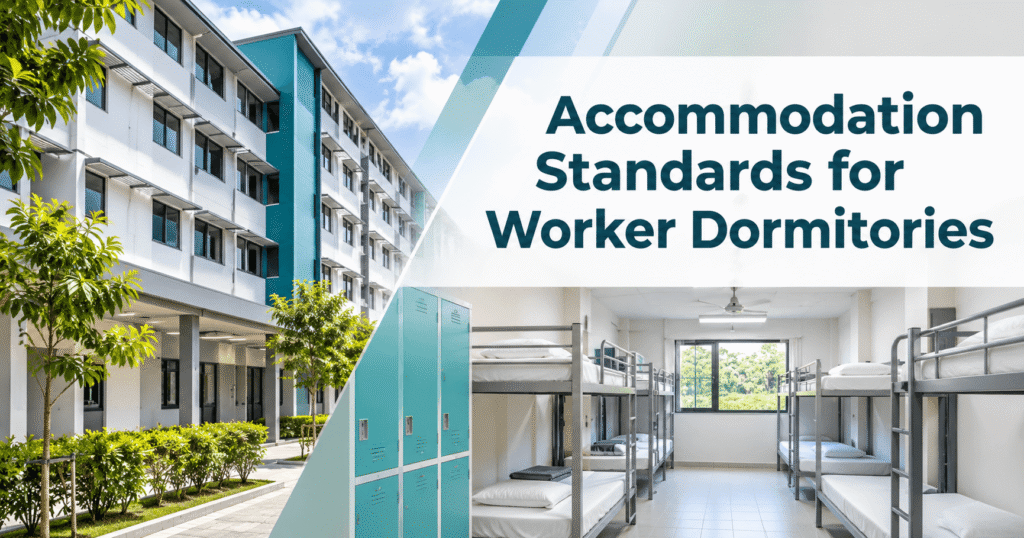
What Are the Accommodation Standards for Worker Dormitories in Singapore?
Singapore is progressively upgrading its foreign worker dormitory standards to improve living conditions.
Existing dormitories are expected to meet the requirements of the Dormitory Transition Scheme (DTS) by 2030 and the New Dormitory Standards (NDS) by 2040, according to the applicable transition framework.
Comparison of Dormitory Accommodation Standards
| Standard | Living Space per Person | Maximum Occupants per Room | Bed Spacing |
| Existing Standards (Set A) | Average 3.5 m² | No specified limit | No specified requirement |
| DTS by 2030 | At least 3.6 m² | 12 | 1 metre recommended |
| NDS by 2040 | At least 4.2 m² | 12 | At least 1 metre |
| Temporary NDS Relaxation (1 Jan 2027 – 31 Jan 2030) | At least 3.6 m² | 14 | At least 1 metre |
On 6 November 2026, MOM announced two temporary relaxation measures intended to increase available dormitory bed capacity.
Eligible dormitory operators must apply for and obtain approval before implementing these measures.
Importantly, these changes do not remove employers’ existing responsibilities to provide suitable accommodation.
Comparing Workers Housing Options in Singapore
For employers arranging accommodation for Work Permit holders, the main options typically include Purpose-Built Dormitories, Factory-Converted Dormitories, HDB flats, and private residential properties.
The most appropriate choice depends on workforce size, worker eligibility, operational requirements, and budget.
Workers Housing Singapore: Accommodation Comparison
| Factor | Purpose-Built Dormitories (PBDs) | Factory-Converted Dormitories (FCDs) | HDB Flats / Private Housing |
| Worker eligibility | Work Permit holders from multiple sectors | Eligible workers depending on the FCD category and permitted arrangements | HDB eligibility depends on nationality and sector; private housing generally accommodates workers across sectors |
| Accommodation capacity | Hundreds to thousands of beds | Tens to hundreds of beds | Generally six occupants, or eight under qualifying conditions |
| Facilities | Shops, cooking areas, laundry and recreational facilities | Basic facilities vary by property | Standard residential facilities |
| Regulatory requirements | FEDA licensing and MOM requirements | FEDA licence required for dormitories housing seven or more workers | HDB/URA regulations and employer compliance responsibilities |
| Employer management requirements | Generally lower, with facilities managed by operators | Moderate | Generally higher, including occupancy and property condition checks |
| Best suited for | Companies with large, relatively stable workforces | Companies seeking accommodation near industrial premises | Smaller eligible teams |
How Much Does Workers Housing Cost in Singapore in 2026?
According to research by Dormitory Association Singapore Limited (DASL) and Knight Frank, the average rental rate for Class 4 Purpose-Built Dormitories reached approximately S$495 per bed per month in the first half of 2026.
This represented an 83.3% increase from S$270 per bed per month in the first half of 2019.
Rental rates also varied by location:
- Western Singapore: approximately S$460 per bed per month.
- Central Singapore: approximately S$535 per bed per month.
These figures provide a market benchmark rather than a fixed rental rate.
Actual accommodation costs depend on location, room configuration, available facilities, contract duration, and market conditions.
Employers should request a written quotation and confirm all applicable charges before committing to a dormitory agreement.
What Should Employers Check Before Renting Worker Dormitories?
When selecting workers housing in Singapore, regulatory compliance is essential, but practical considerations can be equally important.
Drawing on experience managing approximately 23,000 dormitory beds across Singapore, Avery Dormitories recognises that accommodation location plays a significant role in daily workforce operations.
Dormitories situated close to workplaces can help reduce commuting time and make transportation arrangements more convenient for employers and workers.
For this reason, Avery Dormitories operates accommodation near major industrial clusters, including:
- Tampines Dormitory Located near electronics manufacturing and wafer fabrication industries in the Tampines and Changi areas.
- Woodlands Dormitory Positioned to serve industries such as furniture manufacturing, food production, and general manufacturing.
Workers Housing Checklist Before Signing a Rental Agreement
Before finalising an accommodation arrangement, employers should verify the following:
- FEDA licensing: Confirm that the dormitory operator holds a valid licence appropriate to the facility’s accommodation capacity.
- Room capacity: Obtain written confirmation of the living space allocated per worker and the maximum number of occupants per room.
- Upcoming regulatory changes: Check whether the operator intends to implement the temporary 2027 relaxation measures and how these may affect accommodation arrangements.
- Rental agreement: Review rental charges, notice periods, contract duration, and provisions addressing changes in regulatory standards or approvals.
- Workplace accessibility: Evaluate travel distance and commuting time, particularly for workers on shift schedules.
- Facilities: Check the availability of cooking areas, laundry services, shops, recreational spaces, and Wi-Fi.
- Worker support: Confirm that residents have a clear process for reporting maintenance issues or accommodation concerns.
- Address registration: Ensure that workers’ residential addresses are updated in OFWAS within five days of relocation.
A well-planned accommodation arrangement should support legal compliance, operational efficiency, and workers’ everyday living needs.
Conclusion: How to Choose the Right Workers Housing in Singapore
Choosing suitable workers housing in Singapore begins with understanding worker eligibility, followed by regulatory compliance and accommodation costs.
Although MOM permits several types of accommodation, eligibility depends on factors such as nationality, employment sector, and workforce size.
Dormitories housing seven or more foreign workers are subject to FEDA licensing requirements. Accommodation standards are also being progressively upgraded towards the New Dormitory Standards by 2040, with temporary relaxation measures available to qualifying operators between 2027 and 2030.
For smaller eligible teams, HDB flats or private residential properties may provide practical accommodation options.
For employers managing larger workforces, licensed dormitories located near workplaces often offer a practical balance between regulatory compliance, worker welfare, and administrative convenience.
Regardless of the accommodation type selected, employers remain legally responsible for ensuring that their foreign workers have suitable housing.
Looking for compliant workers housing in Singapore near your workplace?
Contact Avery Dormitories to enquire about accommodation availability and submit your booking request.
Frequently Asked Questions (FAQ)
1. Who Is Responsible for Foreign Worker Accommodation in Singapore?
Employers are responsible for providing suitable accommodation under the Employment of Foreign Manpower Act.
This includes ensuring appropriate housing, paying rental fees on time, and updating workers’ residential addresses through OFWAS.
Using a licensed dormitory operator does not remove these responsibilities.
2. Do All Worker Dormitories in Singapore Require a FEDA Licence?
Dormitories accommodating seven or more foreign workers have been required to obtain a FEDA licence since 1 April 2023.
Operating a dormitory without the required licence may result in a fine of up to S$500,000, imprisonment for up to two years, or both.
3. Can Work Permit Holders Stay in HDB Flats?
Certain Work Permit holders may stay in HDB flats, depending on nationality and employment sector.
Malaysian Work Permit holders and eligible services sector workers may rent HDB flats, while non-Malaysian manufacturing workers may rent rooms but not entire flats.
Employers should confirm the latest eligibility requirements before arranging accommodation.
4. How Much Does Workers Housing Cost in Singapore?
The average rental rate for Class 4 Purpose-Built Dormitories in the first half of 2026 was approximately S$495 per bed per month, according to research by DASL and Knight Frank.
Actual prices depend on location, room capacity, facilities, and contract terms.
Employers should obtain written quotations before confirming accommodation.
5. How Will Worker Dormitory Standards Change from 1 January 2027?
Eligible dormitories subject to the New Dormitory Standards may apply for temporary relaxation measures.
Subject to MOM approval, qualifying facilities may provide at least 3.6 square metres of living space per resident and accommodate up to 14 occupants per room until 31 January 2030.
A minimum distance of one metre between beds must still be maintained.
6. How Quickly Must Employers Update Workers’ Residential Addresses?
Employers must update workers’ residential addresses through OFWAS within five days of a change in accommodation.
MOM may verify registered addresses, and failure to maintain accurate records can result in enforcement action, including restrictions affecting future Work Permit applications.
References
- Ministry of Manpower — Various Types of Housing and Their Specific Requirements (Updated 2 June 2026) https://www.mom.gov.sg/passes-and-permits/work-permit-for-foreign-worker/housing/various-types-of-housing
- Ministry of Manpower — Employer’s Responsibilities for Housing https://www.mom.gov.sg/passes-and-permits/work-permit-for-foreign-worker/housing/employers-responsibilities
- Ministry of Manpower — Apply for a FEDA Licence https://www.mom.gov.sg/passes-and-permits/work-permit-for-foreign-worker/housing/apply-for-a-feda-licence
- Ministry of Manpower — Dormitory Transition Scheme https://www.mom.gov.sg/passes-and-permits/work-permit-for-foreign-worker/housing/requirements-for-dormitory-operators/dormitory-transition-scheme
- Ministry of Manpower — Interim Relaxation of New Dormitory Standards (6 November 2026) https://www.mom.gov.sg/newsroom/announcements/2026/1106-interim-relaxation-of-nds-for-migrant-worker-dormitories
- Ministry of Manpower — Company and General Manager Charged Under FEDA for Operating an Unlicensed Dormitory (October 2026) https://www.mom.gov.sg/newsroom/press-releases/2026/2910-company-and-general-manager-charged-under-the-feda-for-operating-an-unlicensed-dormitory
- NTUC — 1,600 Foreign Worker Dormitories to Be Licensed Under Single Legislation https://www.ntuc.org.sg/essu/news/1600-Foreign-Worker-Dormitories-to-Be-Licensed-under-Single-Legislation-to-Raise-Standards-and-Contain-Disease-Outbreaks/
- EdgeProp Singapore — Workers’ Dormitory Rents Resume Growth in 1H2026 (8 September 2026) https://www.edgeprop.sg/property-news/worker-dormitory-rents-resume-growth-1h2026-despite-easing-occupancy
- Little Big Employment Agency — New Dormitory Standards: The 1 January 2027 Interim Relaxation (8 November 2026) https://singaporeemploymentagency.com/new-dormitory-standards-singapore-interim-relaxation-2027/
- Yahoo News — 1,600 Worker Dorms to Be Under Single Law https://malaysia.news.yahoo.com/1600-worker-dorms-single-law-curb-disease-outbreaks-090206350.html